
AestheticUndated
Cyberpunk aesthetic
Dense technological environments combine luminous interfaces, urban texture and a sense of friction or decay.
Layered signage
Luminous horizons, reflective surfaces and receding grids build a stylized electronic atmosphere.
Synthwave, also known as retrowave, is an electronic music microgenre that draws on film soundtracks of the 1970s and 1980s and is driven by nostalgia for 1980s culture. It arose in France and Western Europe in the mid-to-late 2000s, with French producers such as Kavinsky and College among its pioneers. Its visual side is central to its identity, typically combining magenta neon light, gridlines and geometric patterns, VHS tracking artifacts and imagery indebted to Miami Vice and 1980s technology.
Historical context draws on the supplied research. Approximate periods are reference ranges, not fixed boundaries. See the source notes below.
Choose a single lighting logic and protect text contrast.
A grid and a sunset can become a cliché without a specific compositional idea.
Dense technological environments combine luminous interfaces, urban texture and a sense of friction or decay.
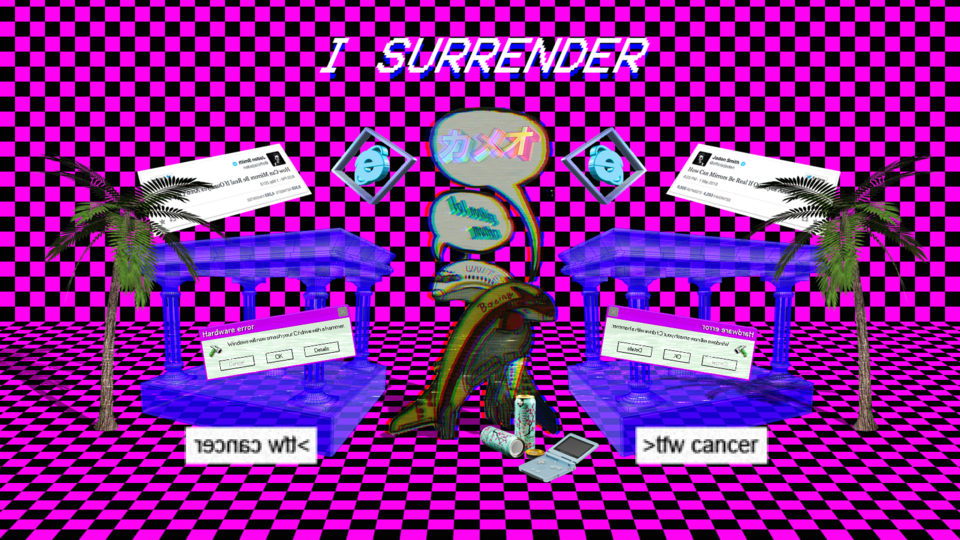
Detached commercial imagery, artificial surfaces and disrupted digital space create an atmosphere of mediated nostalgia.